2026 Federal vs. State Financial Aid: A Comprehensive Comparison

Securing higher education funding in 2026 hinges on understanding the distinct advantages and limitations of federal versus state-sponsored financial aid programs to strategically maximize support.
Navigating the complex landscape of college funding can be daunting, but understanding the differences in federal vs state aid is paramount for students and families. As we look towards 2026, the mechanisms for financing higher education continue to evolve, presenting both opportunities and challenges for aspiring students across the United States.
Understanding the foundations of federal financial aid in 2026
Federal financial aid programs, primarily managed by the U.S. Department of Education, form the bedrock of college funding for millions of students. These programs are designed to make higher education accessible to a broad spectrum of the population, regardless of socioeconomic background. In 2026, the core tenets of federal aid, including FAFSA submission and need-based assessments, remain central to eligibility.
The federal government offers a diverse portfolio of financial assistance, encompassing grants, work-study programs, and various loan options. Each category serves a distinct purpose, catering to different student needs and financial situations. The application process, standardized through the Free Application for Federal Student Aid (FAFSA), is a critical first step for almost all students seeking financial assistance.
Key federal aid programs and their characteristics
Several flagship programs fall under the federal aid umbrella, each with its unique criteria and benefits. Understanding these individual programs is essential for students to identify the most suitable options for their educational journey.
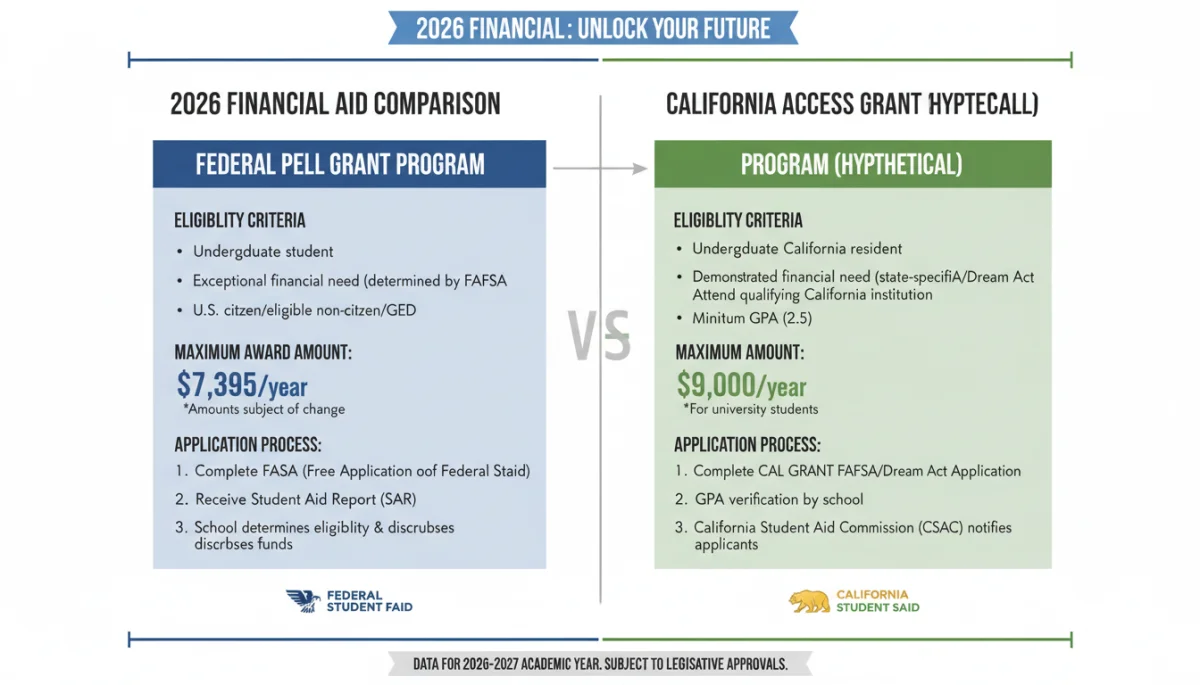
- Pell Grants: These are need-based grants, meaning they do not have to be repaid. Eligibility is determined by financial need, cost of attendance, and enrollment status.
- Federal Supplemental Educational Opportunity Grants (FSEOG): Administered directly by colleges, FSEOG provides additional grant money to students with exceptional financial need who also receive Pell Grants.
- Federal Work-Study Program: This program allows students to earn money to help pay for educational expenses through part-time employment, often in community service or jobs related to their field of study.
- Federal Student Loans: These include Direct Subsidized Loans, Direct Unsubsidized Loans, Direct PLUS Loans, and Direct Consolidation Loans. They offer various repayment plans and generally have lower interest rates and more flexible terms than private loans.
The defining characteristic of federal aid is its broad applicability and generally more favorable terms compared to private lending. Federal student loans, for instance, often feature fixed interest rates, income-driven repayment options, and opportunities for loan forgiveness in specific circumstances. These protections are invaluable for students facing economic uncertainty post-graduation. The federal system also emphasizes transparency, with clear guidelines and resources available to help students navigate the application and repayment processes.
Exploring the landscape of state-sponsored financial aid in 2026
Beyond federal initiatives, each state in the U.S. operates its own array of financial aid programs, often designed to incentivize students to attend in-state institutions or pursue specific fields of study. These state-sponsored programs can significantly supplement federal aid, providing an additional layer of financial support for eligible students. In 2026, many states are expected to continue their focus on retaining talent and addressing workforce needs through targeted aid.
State aid can vary dramatically from one state to another, reflecting diverse legislative priorities, economic conditions, and educational goals. Some states offer generous grant programs for residents, while others might focus more on scholarships for academic achievement or specific demographic groups. The application process for state aid often mirrors the federal FAFSA, but many states also require supplementary applications or specific residency documentation.
Variety and eligibility for state aid programs
The sheer variety of state aid programs means that students must research their specific state’s offerings thoroughly. Eligibility criteria can be highly localized, emphasizing residency, academic performance, or enrollment in particular programs.
- State Grants and Scholarships: Many states offer their own versions of need-based grants, similar to Pell Grants, and merit-based scholarships for academic excellence. Examples include the Cal Grant in California or the Tuition Assistance Program (TAP) in New York.
- Special Programs: Some states have programs targeting specific populations, such as students pursuing careers in high-demand fields like teaching or healthcare, or those from underrepresented backgrounds.
- Tuition Waivers: Certain states and public institutions offer tuition waivers for specific categories of students, such as veterans, foster youth, or senior citizens.
- Loan Programs: While less common than grants or scholarships, some states also operate their own student loan programs, often with competitive interest rates for residents.
A key differentiator for state aid is its strong emphasis on residency. Most state programs are exclusively available to students who are legal residents of that state, often requiring a certain period of residency prior to application. This focus aims to bolster the state’s own higher education system and workforce. Furthermore, state aid can be highly competitive, with limited funds often allocated on a first-come, first-served basis, underscoring the importance of early application.
Comparing funding amounts: federal vs state aid in 2026
When it comes to the sheer volume of funds disbursed, federal financial aid typically dwarfs state-sponsored aid. The U.S. government allocates billions of dollars annually to its various programs, making it the largest source of financial assistance for higher education. This extensive funding allows federal programs to support a vast number of students across all states and institutions.
However, while federal aid may offer larger overall pots of money, state aid can sometimes provide more significant individual awards, especially for specific categories of students or those attending in-state public universities. The impact of state aid can be particularly pronounced in states with strong commitments to higher education funding, where state grants might cover a substantial portion of tuition.
Analyzing the scope and depth of aid offerings
The comparison of funding amounts isn’t just about the total dollar figures but also about the depth and breadth of the aid offered. Federal aid provides a universal safety net, ensuring a baseline level of support for students nationwide, while state aid often fills in the gaps or provides specialized assistance.
- Federal Reach: Federal programs like Pell Grants and federal student loans are available nationwide to eligible students, offering a consistent standard of assistance.
- State Specificity: State aid is inherently localized, often providing more targeted support for residents, which can lead to higher individual awards in certain contexts.
- Combined Impact: The most effective strategy for students is typically to combine both federal and state aid. Federal Pell Grants, for example, can be stacked with state grants and scholarships, significantly reducing out-of-pocket costs.
The maximum award amounts for federal programs, such as the Pell Grant, are set annually by Congress and can fluctuate. Similarly, state legislatures determine the funding levels for their respective programs, which are subject to state budgets and economic conditions. Therefore, students in 2026 must pay close attention to the latest figures and legislative changes at both federal and state levels to accurately project their potential aid.
Eligibility criteria: who qualifies for what in 2026?
Eligibility for both federal and state financial aid in 2026 hinges on a combination of factors, though the emphasis can differ significantly between the two. Federal aid primarily focuses on financial need, academic progress, and enrollment status, while state aid often introduces additional criteria related to residency and specific academic or demographic profiles.
The FAFSA remains the gateway to federal aid, collecting comprehensive financial information to determine a student’s Expected Family Contribution (EFC) – soon to be replaced by the Student Aid Index (SAI) – which is critical for need-based programs. State aid programs, while often utilizing FAFSA data, frequently require supplementary applications to verify state residency and other specific qualifications.
Key eligibility differences and how to prepare
Understanding these distinct eligibility requirements is crucial for students to maximize their chances of receiving financial assistance. Missing a deadline or failing to provide specific documentation can result in lost opportunities.
- Federal Aid Core Requirements:
- U.S. citizenship or eligible non-citizen status.
- Valid Social Security number.
- High school diploma or GED certificate.
- Enrollment in an eligible degree or certificate program.
- Maintain satisfactory academic progress.
- Not be in default on any federal student loan or owe a refund on a federal grant.
- State Aid Additional Requirements (Common Examples):
- Specific period of state residency (e.g., 12 consecutive months).
- Enrollment in a state public institution.
- Minimum GPA or specific academic achievements.
- Participation in certain community service or volunteer activities.
- Pursuit of a degree in a high-demand field within the state.
The process of determining eligibility can feel complex, but resources are available. High school guidance counselors, college financial aid offices, and state higher education agencies are excellent sources of information. Students should proactively engage with these resources to ensure they meet all necessary criteria and submit applications accurately and on time. Early preparation, including gathering all required documents, is often the most significant factor in successfully securing aid.
Application processes and deadlines for 2026 aid cycles
The journey to securing financial aid, whether federal or state, begins with understanding and adhering to the respective application processes and critical deadlines. While the FAFSA serves as the universal application for federal aid, state aid often introduces additional forms and unique submission windows. For 2026, students should anticipate a continuation of these established procedures, with a strong emphasis on timely submission.
The FAFSA typically opens in October for the following academic year, and submitting it as early as possible is highly recommended. This is because some federal and, crucially, many state and institutional aid programs award funds on a first-come, first-served basis until funds are depleted. Procrastination can lead to missing out on valuable aid, even if a student is otherwise eligible.
Navigating the application landscape
Students must meticulously track all deadlines, which can vary not only by state but also by individual institution. Creating a comprehensive checklist can be incredibly helpful in managing the various requirements.
- Federal FAFSA Application:
- Available annually, typically starting October 1st.
- Requires tax information from two years prior (e.g., 2024 tax info for the 2026-2027 academic year).
- Submission is entirely online, though paper forms are available.
- Federal deadline is usually in June, but state and institutional deadlines are much earlier.
- State Aid Applications:
- Many states have their own application portals or require state-specific forms in addition to the FAFSA.
- Deadlines vary widely by state; some are as early as January or February.
- Some states require an additional state grant application or a specific residency affidavit.
- Institutional Aid Applications:
- Colleges often have their own financial aid applications (e.g., CSS Profile for private institutions).
- These deadlines are set by the individual college and can be very early in the application cycle.
It’s vital for students to check the websites of their prospective colleges and their state higher education agency for the most accurate and up-to-date information on deadlines and required documentation. Missing a deadline, even by a day, can mean forfeiting thousands of dollars in potential aid. Additionally, students should be prepared to provide supporting documentation if selected for verification, a process that ensures the accuracy of the information submitted on the FAFSA.
Maximizing your financial aid package: strategies for 2026
To truly maximize their financial aid package in 2026, students must adopt a strategic and proactive approach. This involves not only understanding the nuanced differences between federal and state aid but also actively pursuing all available avenues of funding. A well-rounded strategy combines early application, thorough research, and persistent follow-up.
The goal is to stack different types of aid – grants, scholarships, and potentially work-study – to minimize reliance on loans. While federal student loans offer favorable terms, reducing the amount borrowed can significantly alleviate future financial burdens. State-specific scholarships and grants often provide excellent opportunities to achieve this, especially for students attending public in-state institutions.
Effective strategies for securing more aid
A multi-pronged approach often yields the best results. Students should not limit themselves to just one type of aid or one application, but rather explore every possible option.
- Apply Early: Submit the FAFSA and any state-specific applications as soon as they become available. Funds are often limited and awarded on a first-come, first-served basis.
- Research State-Specific Programs: Dive deep into your state’s higher education agency website to uncover grants and scholarships tailored to residents.
- Explore Institutional Aid: Many colleges offer their own scholarships and grants, often based on merit, need, or specific talents. Check with each school’s financial aid office.
- Seek Outside Scholarships: Don’t overlook scholarships from private organizations, foundations, and community groups. These can be highly specialized and less competitive than national awards.
- Understand Appeal Processes: If your financial circumstances change or you believe your aid package doesn’t accurately reflect your need, inquire about the appeal process with your college’s financial aid office.
- Consider Work-Study: If eligible, participate in the Federal Work-Study program to earn money for expenses while gaining valuable experience.
Furthermore, maintaining strong academic performance can open doors to merit-based scholarships at both the state and institutional levels. Students should also consider the cost of attendance when choosing a college, as a lower-cost institution might result in a more manageable financial aid gap, even with less overall aid. Ultimately, a proactive and informed approach to financial aid can significantly impact the affordability and accessibility of higher education in 2026.
The future outlook: trends impacting financial aid in 2026 and beyond
The landscape of financial aid is not static; it is continually shaped by economic conditions, legislative priorities, and technological advancements. As we look towards 2026 and beyond, several trends are likely to influence both federal and state-sponsored financial aid programs, impacting how students access and receive funding for higher education.
One significant trend is the ongoing debate around student loan debt and calls for reform. This could lead to further adjustments in federal loan programs, potentially introducing new repayment options or expanding loan forgiveness initiatives. At the state level, increased focus on workforce development might translate into more scholarships for students pursuing degrees in high-demand sectors like STEM, healthcare, or skilled trades.
Emerging trends and their potential impact
Staying informed about these evolving trends will be crucial for prospective students and their families to adapt their financial aid strategies.
- FAFSA Simplification: Ongoing efforts to simplify the FAFSA process aim to make it easier for students to apply for aid, potentially increasing access for underserved populations.
- Increased State Investment: Some states may increase their investment in higher education funding, recognizing its importance for economic growth and competitiveness. However, this can be heavily dependent on state budgets.
- Performance-Based Funding: A growing number of states are tying funding for public institutions to student outcomes, which could indirectly influence institutional aid policies.
- Focus on Affordability: With rising college costs, there’s a continuous push from policymakers to enhance affordability, which may lead to new grant programs or tuition caps.
- Digitalization of Services: Expect more financial aid processes to move online, streamlining application and management, but also requiring students to be digitally literate.
The interplay between federal and state policies will continue to be a dynamic area. Federal initiatives often set a national standard, while states innovate with programs tailored to their unique needs. Students in 2026 should remain vigilant for legislative updates and policy changes at both levels. Engaging with elected officials and advocating for robust financial aid policies can also play a role in shaping the future of college affordability. Ultimately, a responsive and adaptable approach to financial planning will be key in navigating the evolving aid landscape.
| Key Aspect | Brief Description |
|---|---|
| Funding Source | Federal aid from U.S. government; State aid from individual state governments. |
| Eligibility Focus | Federal emphasizes financial need; State includes residency, specific academics, or demographics. |
| Aid Types | Both offer grants, scholarships, work-study, and loans, but specific programs vary. |
| Application Process | FAFSA for federal; FAFSA plus state-specific applications for state aid. |
Frequently asked questions about 2026 financial aid
Federal aid originates from the U.S. government, offering broad programs like Pell Grants and federal loans. State aid comes from individual state governments, often targeting residents, specific academic achievements, or in-state institutions, varying significantly by location.
Federal financial aid generally disburses a larger total amount of funds nationwide due to its extensive reach. However, state aid can sometimes provide more substantial individual awards, especially for residents attending in-state public universities or pursuing specific fields.
Yes, in most cases, completing the FAFSA is a prerequisite for state financial aid, as states often use FAFSA data to determine eligibility and financial need. Many states also require additional, state-specific application forms or residency verification.
The renewability of state grants and scholarships varies by program and state. Many require students to maintain a certain GPA, demonstrate continued financial need, or remain enrolled in an eligible program to renew their awards each academic year.
The most effective strategy is to apply for both federal and state aid as early as possible, thoroughly research all available programs, and actively seek out institutional and private scholarships. Stacking different aid types helps minimize reliance on loans.
Conclusion
As students and families prepare for higher education in 2026, a comprehensive understanding of both federal and state-sponsored financial aid is indispensable. While federal aid offers a broad safety net and foundational support, state programs provide critical supplementary funds, often with specific benefits for residents or those pursuing particular academic paths. The key to unlocking the most robust financial aid package lies in diligent research, timely application, and a proactive approach to exploring every available resource. By strategically combining federal grants, loans, and work-study with state-specific scholarships and grants, students can significantly reduce the financial burden of college, making their educational aspirations a more attainable reality. Staying informed about evolving policies and deadlines at both levels will be crucial for navigating the financial aid landscape successfully.
