Micro-Credentials: US Learners’ Path to 2026 Success

The Rise of Micro-Credentials: How US Learners Can Benefit from Short-Term Programs in 2026 offers agile skill acquisition, directly enhancing career readiness for the evolving job market.
The landscape of education and employment is undergoing a profound transformation, with the rise of micro-credentials: how US learners can benefit from short-term programs in 2026 emerging as a pivotal force. These focused, verifiable qualifications are reshaping how Americans acquire new skills, adapt to industry demands, and advance their careers in an increasingly dynamic economy.
Understanding the Micro-Credential Revolution
Micro-credentials represent a significant shift from traditional, long-form degrees. They are bite-sized, competency-based certifications that validate specific skills or knowledge areas. This approach allows learners to target precise competencies needed for job roles or career advancement without committing to extensive, multi-year programs.
The appeal of micro-credentials lies in their agility and relevance. In a rapidly changing job market where technologies and industry practices evolve constantly, these short-term programs offer a quick and effective way to upskill or reskill. They are particularly valuable for individuals looking to pivot careers, fill skill gaps, or stay competitive in their current fields.
What defines a micro-credential?
Micro-credentials typically possess several key characteristics that distinguish them from other forms of education. Understanding these features is crucial for appreciating their value in today’s educational ecosystem.
- Focused Learning: They concentrate on a narrow set of skills or knowledge.
- Competency-Based: Assessment focuses on demonstrating mastery of specific tasks.
- Verifiable: Credentials are often digitally badge-based and easily shared.
- Flexible: Programs can be completed in weeks or months, not years.
These attributes make micro-credentials an attractive option for a diverse range of learners, from recent high school graduates exploring career paths to seasoned professionals seeking specialized expertise. They provide a practical bridge between academic learning and immediate workforce needs.
In conclusion, the micro-credential revolution is fundamentally about democratizing access to specialized skills. By offering flexible, targeted, and verifiable learning pathways, these programs are empowering US learners to navigate the complexities of modern employment with greater confidence and capability. Their growing acceptance by employers further solidifies their role in future workforce development.
Why Micro-Credentials are Gaining Traction in the US
The increasing popularity of micro-credentials in the United States is not accidental; it’s a direct response to several converging economic, technological, and societal trends. Traditional education models, while still valuable, often struggle to keep pace with the rapid changes in industry demands, leaving a gap that micro-credentials are uniquely positioned to fill.
One primary driver is the accelerating pace of technological innovation. Industries like IT, healthcare, and advanced manufacturing require workers with highly specialized and constantly updated skills. Micro-credentials provide a streamlined way for individuals to acquire these in-demand competencies without undergoing lengthy degree programs.
Addressing the skills gap
The US economy faces a persistent skills gap, with employers struggling to find candidates possessing the specific proficiencies needed for critical roles. Micro-credentials offer a targeted solution, allowing learners to acquire precisely those skills that are most valued in the job market, thereby reducing the mismatch between available talent and employer needs.
Furthermore, the cost and time commitment associated with traditional higher education have become significant barriers for many. Micro-credentials present a more affordable and time-efficient alternative, opening doors for individuals who might otherwise be unable to pursue further education. This accessibility is crucial for fostering a more inclusive and skilled workforce.
- Rapid Skill Acquisition: Learn new skills quickly to meet market demands.
- Cost-Effectiveness: Generally more affordable than traditional degrees.
- Career Advancement: Boost employability and promotion opportunities.
- Flexibility: Often available online, accommodating busy schedules.
The growing recognition of micro-credentials by employers is also a key factor. As more companies understand the value of these focused certifications, they are increasingly incorporating them into their hiring and professional development strategies. This acceptance creates a positive feedback loop, encouraging more learners to pursue micro-credential pathways.
In summary, the rise of micro-credentials in the US is a multifaceted phenomenon driven by the need for rapid skill adaptation, affordability, and employer recognition. These programs are not just an alternative to traditional education but a vital complement, ensuring that the US workforce remains competitive and agile in the global economy.
Key Benefits for US Learners in 2026
For US learners looking ahead to 2026, embracing micro-credentials offers a compelling suite of advantages that can significantly impact their career trajectories and personal development. These benefits extend beyond mere skill acquisition, touching upon aspects of financial well-being, career agility, and lifelong learning.
One of the most immediate benefits is enhanced employability. In a job market that increasingly values demonstrated skills over broad academic qualifications, micro-credentials provide tangible proof of specific competencies. This can make a candidate stand out, particularly for roles requiring specialized technical or soft skills.
Career flexibility and adaptability
The modern career path is rarely linear. Micro-credentials empower learners with the flexibility to pivot between industries, adapt to new job functions, and remain relevant in an ever-evolving professional landscape. They enable individuals to strategically build a diverse skill set that can be applied across various contexts.
Moreover, the convenience of micro-credentials cannot be overstated. Many programs are offered online, allowing learners to balance their studies with existing work and family commitments. This accessibility removes geographical barriers and provides opportunities for individuals in rural areas or those with limited access to traditional educational institutions.
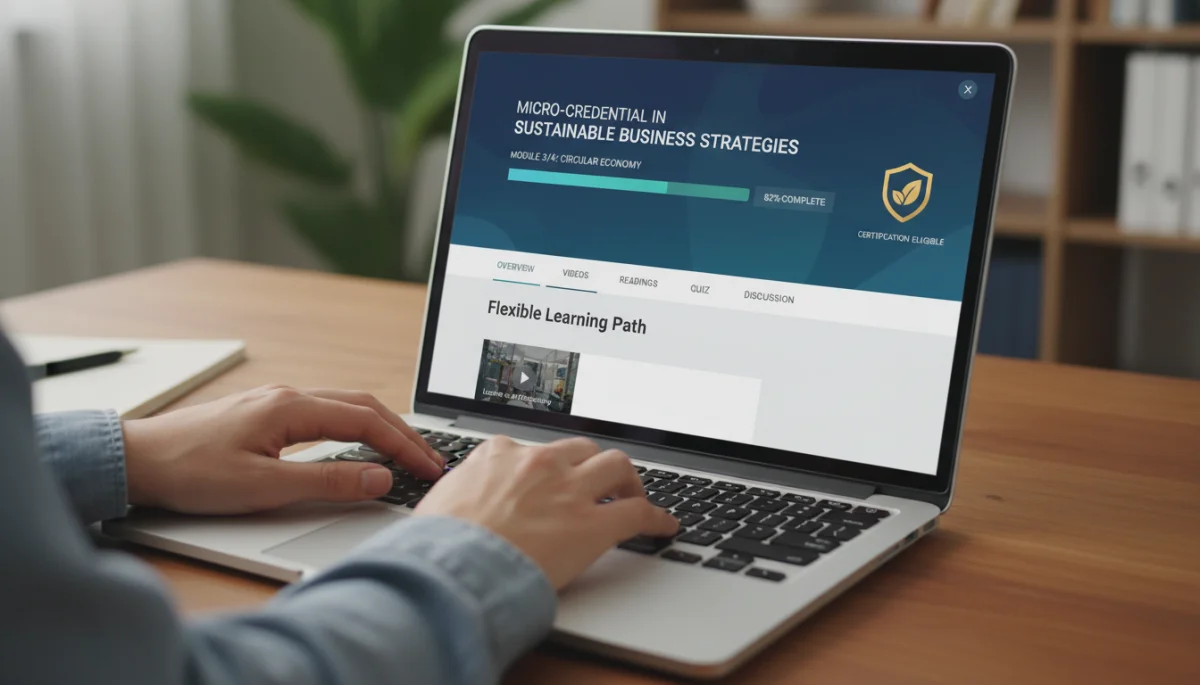
Another crucial benefit is the potential for increased earning potential. By acquiring in-demand skills, individuals can qualify for higher-paying jobs or negotiate better salaries. This direct link between skill acquisition and financial reward makes micro-credentials a smart investment for career-minded individuals.
- Targeted Skill Acquisition: Focus on skills directly relevant to job market needs.
- Faster Time to Market: Quickly gain qualifications for new roles or promotions.
- Reduced Educational Debt: Lower costs compared to traditional degrees.
- Personalized Learning: Customize learning paths to individual goals.
In essence, micro-credentials are not just about learning; they are about strategic learning that directly translates into tangible benefits for US learners in 2026. They offer a pathway to a more adaptable, financially secure, and personally fulfilling career.
Integrating Micro-Credentials with Traditional Education
Far from being a replacement for traditional degrees, micro-credentials are increasingly seen as a powerful complement, creating a more holistic and responsive educational ecosystem. The integration of these short-term programs with traditional education offers a nuanced approach to skill development that benefits both institutions and learners.
Many universities and colleges are now incorporating micro-credentials into their curricula, offering them as standalone programs or as modules within broader degree pathways. This allows students to earn specialized certifications alongside their degrees, making them more competitive upon graduation.
Bridging academic theory and practical application
Traditional education often provides a strong theoretical foundation, while micro-credentials excel at delivering practical, job-specific skills. By combining these two approaches, learners gain a robust understanding of foundational concepts as well as the hands-on abilities required to excel in the workforce. This hybrid model prepares graduates more effectively for the demands of the modern job market.
Furthermore, micro-credentials can serve as pathways to further education. Some institutions offer credit for successfully completed micro-credentials, allowing learners to stack these certifications towards a degree. This ‘stackable’ approach provides flexible entry and exit points into higher education, accommodating diverse learning needs and life circumstances.
- Enhanced Degree Value: Supplement degrees with in-demand practical skills.
- Credit for Prior Learning: Potentially earn academic credit for micro-credentials.
- Lifelong Learning Pathways: Create continuous learning opportunities.
- Institutional Innovation: Universities can respond faster to industry needs.
The collaboration between traditional institutions and micro-credential providers is fostering a more agile and responsive educational landscape. It ensures that learners have access to a wide array of learning options, from foundational knowledge to highly specialized competencies, preparing them for a future where continuous learning is paramount.
Ultimately, the integration of micro-credentials with traditional education is about creating a more dynamic and effective learning journey. It allows US learners to leverage the best of both worlds, acquiring comprehensive knowledge alongside targeted, marketable skills that are crucial for success in 2026 and beyond.
Challenges and Considerations for Widespread Adoption
While the benefits of micro-credentials are clear, their widespread adoption in the US faces several challenges and considerations that need to be addressed. Overcoming these hurdles is crucial for micro-credentials to reach their full potential and truly transform the American learning and employment landscape.
One significant challenge is the lack of universal standards and recognition. With numerous providers offering various micro-credentials, employers can find it difficult to assess the quality and equivalence of these certifications. This fragmentation can hinder employer trust and limit the portability of credentials across different organizations.
Ensuring quality and employer trust
To foster greater trust, there is a growing need for industry-recognized frameworks and quality assurance mechanisms for micro-credentials. Accreditation bodies and industry associations play a vital role in establishing benchmarks that ensure the rigor and relevance of these programs. Without clear standards, the value proposition of micro-credentials can be diluted.
Another consideration is equitable access. While micro-credentials are often more affordable than degrees, financial barriers can still exist for some learners. Ensuring that these programs are accessible to individuals from all socioeconomic backgrounds, possibly through scholarships, grants, or employer-sponsored programs, is essential for promoting inclusivity.
Furthermore, guiding learners through the vast array of available micro-credentials can be daunting. Effective career counseling and guidance systems are needed to help individuals identify the most relevant and valuable programs for their career goals. Without proper guidance, learners might invest in credentials that do not align with their professional aspirations or market demands.
- Standardization: Develop common frameworks for quality and recognition.
- Funding Models: Explore innovative financing for accessible learning.
- Guidance Systems: Provide robust career counseling for learners.
- Employer Awareness: Educate employers on the value of diverse credentials.
Addressing these challenges requires collaborative efforts from educational institutions, employers, policymakers, and credentialing bodies. By working together, stakeholders can build a more robust and trustworthy ecosystem for micro-credentials, ensuring their sustained impact on US learners and the economy.
In conclusion, while micro-credentials offer immense promise, their path to widespread adoption is not without obstacles. Strategic efforts to standardize quality, ensure equitable access, and enhance guidance will be vital in solidifying their role as a transformative force in US education and workforce development.
The Future Outlook: Micro-Credentials in 2026 and Beyond
Looking towards 2026 and beyond, the trajectory for micro-credentials in the US appears to be one of continued growth and increasing integration into the fabric of lifelong learning and workforce development. These programs are poised to become an indispensable tool for individuals and organizations navigating the complexities of the future.
The demand for agile, responsive learning solutions will only intensify as technological advancements, such as artificial intelligence and automation, continue to reshape job roles and create new industries. Micro-credentials offer the flexibility needed to quickly acquire the skills necessary to thrive in these evolving environments.
Personalized learning pathways
The future will likely see a greater emphasis on personalized learning pathways, where individuals can curate their own educational journeys by stacking various micro-credentials to meet specific career goals. This bespoke approach to skill development will empower learners with greater agency over their professional growth.
Furthermore, employer engagement with micro-credentials is expected to deepen. Companies will likely play a more active role in co-creating micro-credential programs with educational providers, ensuring that the skills taught are directly aligned with their immediate and future workforce needs. This collaborative model will strengthen the relevance and impact of these certifications.
Government initiatives and policy support will also be crucial in facilitating the growth of micro-credentials. Policies that promote standardization, provide funding for learners, and recognize these credentials in public sector hiring can significantly accelerate their adoption and impact across the nation.
- Continuous Evolution: Programs will adapt to emerging industry needs.
- AI-Driven Matching: Better alignment of credentials with job opportunities.
- Global Recognition: Increased portability across international borders.
- Accessibility for All: Efforts to reduce barriers to entry for diverse learners.
Ultimately, micro-credentials are not just a temporary trend but a fundamental shift in how learning and work are interconnected. They represent a future where education is more accessible, responsive, and directly tied to the demands of a dynamic global economy.
In conclusion, the outlook for micro-credentials in 2026 and beyond is bright. They are set to play an increasingly vital role in empowering US learners, fostering a skilled workforce, and driving economic resilience in an era of constant change.
| Key Aspect | Description |
|---|---|
| Flexibility | Short-term programs adapt to busy schedules and diverse learning needs. |
| Skill Relevance | Focus on in-demand skills directly applicable to current job market needs. |
| Career Advancement | Boosts employability and opens doors for new career opportunities. |
| Cost-Effectiveness | More affordable than traditional degrees, reducing financial burden. |
Frequently Asked Questions About Micro-Credentials
A micro-credential is a certification validating specific skills or competencies acquired through short-term, focused learning programs. They are often digitally verifiable and designed to meet immediate workforce needs, offering a flexible alternative to traditional degrees.
US learners benefit from micro-credentials through enhanced employability, rapid skill acquisition, cost-effectiveness, and increased career flexibility. They allow individuals to stay competitive in a fast-evolving job market without extensive time or financial commitments.
Micro-credentials are typically not designed to replace traditional degrees but rather to complement them. They offer specialized skills that can enhance a degree or provide focused training for specific job roles, often in a more time-efficient manner.
Yes, employer recognition of micro-credentials is growing, especially for in-demand skills. Many companies value these certifications as proof of specific competencies, often integrating them into hiring processes and professional development programs to address skill gaps.
Challenges include the need for universal standards and quality assurance, ensuring equitable access for all learners, and enhancing employer awareness. Addressing these requires collaboration among educators, industry, and policymakers to build trust and widespread acceptance.
Conclusion
The emergence of micro-credentials marks a transformative period in American education and workforce development. As we approach 2026, these short-term, focused programs are proving to be an invaluable asset for US learners seeking to adapt to a rapidly changing economic landscape. By offering flexible, affordable, and highly relevant skill acquisition, micro-credentials empower individuals to enhance their employability, navigate career transitions, and commit to lifelong learning. While challenges in standardization and accessibility remain, the clear benefits and growing recognition by employers position micro-credentials as a cornerstone of future-ready education, driving a more skilled, adaptable, and competitive US workforce.
