Technology in US Classrooms: 2026 & Beyond
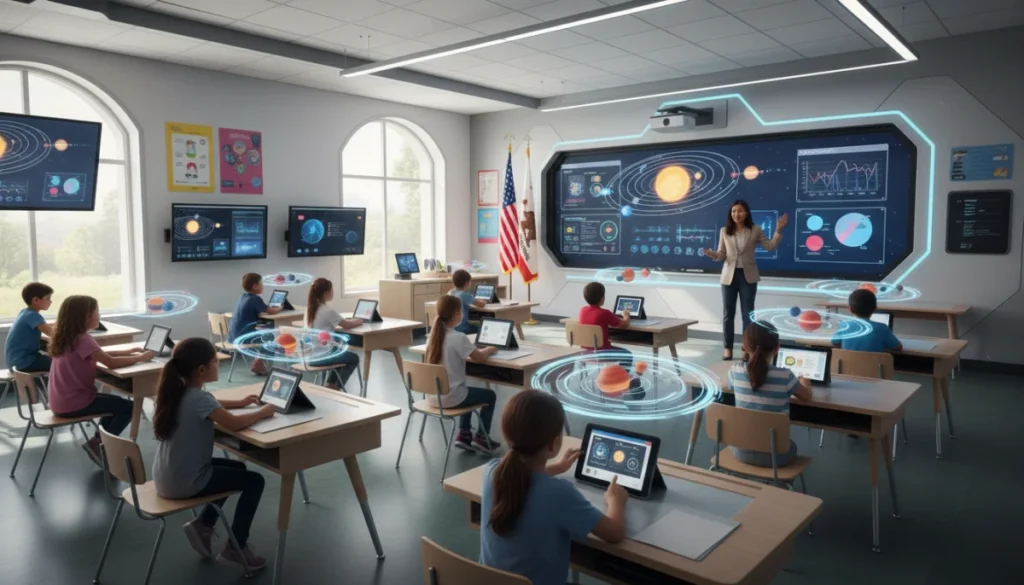
The future of US classrooms from 2026 will be profoundly shaped by technology, integrating AI, fostering digital literacy, and emphasizing equitable access to enhance personalized and engaging learning experiences for all students.
The landscape of education is continuously shifting, and nowhere is this more evident than in the rapid integration of technology into learning environments. As we look towards 2026 and beyond, understanding the evolving role of technology in US classrooms becomes paramount for educators, policymakers, parents, and students alike. This isn’t merely about adding devices; it’s about fundamentally reshaping how knowledge is acquired, shared, and applied.
The AI revolution in personalized learning
Artificial Intelligence (AI) is set to be a cornerstone of educational technology, moving beyond simple automation to truly personalize the learning journey for each student. This shift promises to address long-standing challenges in catering to diverse learning styles and paces.
AI-driven platforms will offer dynamic content adjustments, real-time feedback, and adaptive assessments, creating an educational ecosystem that molds itself around individual needs rather than a one-size-fits-all approach. This isn’t about replacing teachers, but empowering them with tools to become even more effective facilitators of learning.
Adaptive learning pathways
One of the most significant contributions of AI will be the creation of truly adaptive learning pathways. These systems analyze a student’s performance, identify areas of strength and weakness, and then dynamically adjust the curriculum to optimize engagement and comprehension.
- Tailored content delivery: AI will present information in formats best suited for individual students, whether visual, auditory, or kinesthetic.
- Paced learning: Students can progress at their own speed, ensuring mastery before moving on, or accelerating when appropriate.
- Instant feedback: AI tutors can provide immediate, constructive feedback, allowing students to correct misconceptions in real-time.
- Remediation and enrichment: Automated systems can suggest supplementary materials for struggling students or advanced challenges for those excelling.
The integration of AI will transform the classroom into a highly responsive environment, where every student receives an education uniquely designed to maximize their potential. This level of individualization, once a distant ideal, is rapidly becoming a concrete reality, promising more equitable and effective learning outcomes across the US educational system.
Virtual and augmented reality: immersive educational experiences
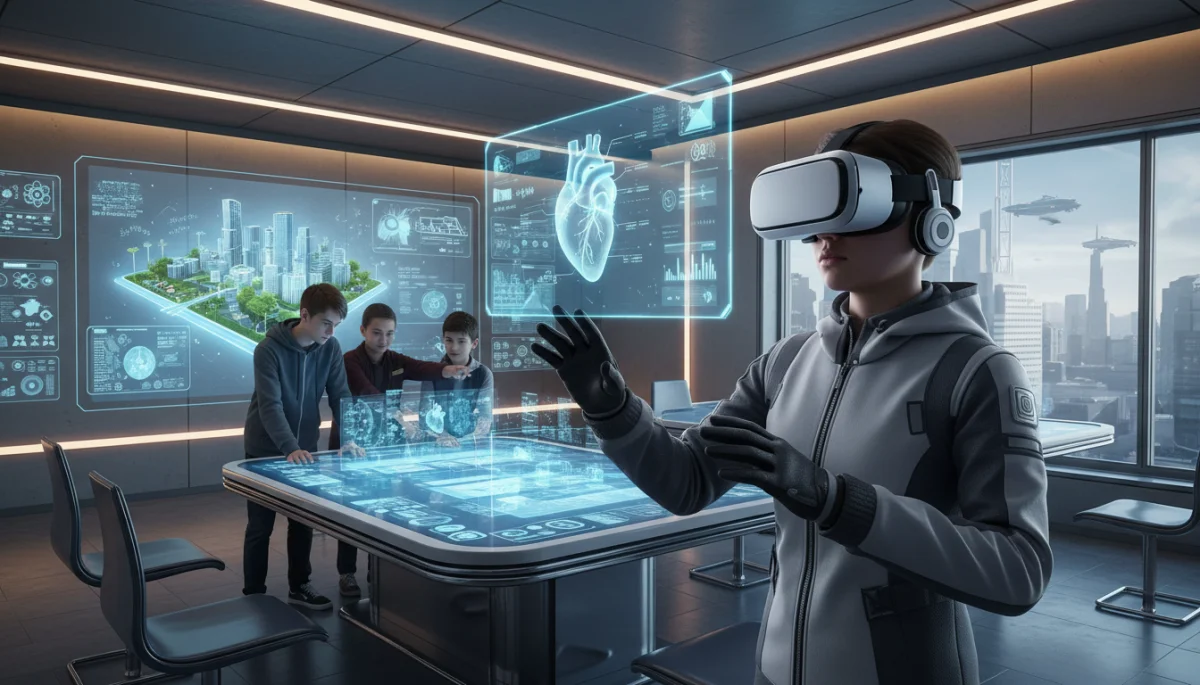
Beyond traditional screens, virtual reality (VR) and augmented reality (AR) are poised to revolutionize how students interact with learning content. These immersive technologies offer unparalleled opportunities to explore complex concepts and historical events in ways that textbooks simply cannot match.
Imagine dissecting a virtual frog without ethical concerns, walking through ancient Rome, or exploring the human circulatory system from within. VR and AR will transform abstract ideas into tangible, memorable experiences, significantly boosting engagement and retention for students across all grade levels.
Bringing lessons to life
VR and AR provide a powerful medium for experiential learning, allowing students to step into simulated environments that were previously inaccessible. This can bridge the gap between theoretical knowledge and practical application.
- Field trips without travel: Students can visit historical sites, scientific laboratories, or even other planets from their classroom.
- Interactive simulations: Complex scientific experiments or engineering challenges can be undertaken in a safe, virtual space.
- Enhanced visualization: Abstract concepts in mathematics or physics can be visualized in 3D, making them easier to grasp.
- Collaborative virtual spaces: Students can work together on projects in shared virtual environments, fostering teamwork skills.
The adoption of VR and AR will move beyond novelty to become integral tools for deep, experiential learning. These technologies will not only make education more exciting but also more effective, providing students with a richer understanding of the world around them and preparing them for a future where such immersive experiences are commonplace.
Fostering digital literacy and citizenship
As technology becomes more ubiquitous in classrooms, the focus will broaden beyond simply using tools to understanding their implications. Developing robust digital literacy and responsible digital citizenship will be critical skills taught alongside traditional subjects.
Students will need to navigate the digital world safely, critically evaluate information, understand data privacy, and communicate effectively online. Schools will play an increasingly vital role in preparing students not just for careers, but for responsible participation in an interconnected global society.
Navigating the digital landscape responsibly
Digital literacy extends far beyond basic computer skills; it encompasses a nuanced understanding of the digital ecosystem and its societal impact. Education will need to equip students with the tools to thrive in this environment.
- Critical evaluation of sources: Teaching students to discern credible information from misinformation online.
- Understanding digital footprints: Educating about privacy, data security, and the permanence of online actions.
- Ethical online behavior: Promoting respect, empathy, and responsible communication in digital interactions.
- Cybersecurity awareness: Basic understanding of how to protect personal information and devices from threats.
The curriculum will evolve to explicitly address these skills, ensuring that students are not just consumers of technology but informed, ethical, and productive digital citizens. This proactive approach will empower the next generation to harness technology’s power while mitigating its potential risks, fostering a more informed and responsible online community.
Ensuring equitable access and bridging the digital divide
The promise of advanced classroom technology can only be fully realized if access is equitable across all socioeconomic strata. The digital divide remains a significant challenge, and addressing it will be a primary focus for educational institutions and policymakers alike.
Initiatives to provide devices, internet access, and digital skills training to underserved communities will intensify. The goal is to ensure that every student, regardless of their background or location, has the opportunity to benefit from the technological advancements transforming education.
Strategies for inclusive technology integration
Achieving true equity in technology integration requires a multi-faceted approach that considers infrastructure, resources, and pedagogical support. This includes both hardware and human capital investments.
- Device provision programs: School districts and government initiatives providing laptops, tablets, or other necessary hardware to students.
- Broadband access initiatives: Expanding reliable, affordable internet access to all homes, especially in rural and low-income areas.
- Teacher professional development: Training educators to effectively integrate technology and support students with varying levels of digital literacy.
- Accessible learning platforms: Ensuring that all digital tools and content are designed to be accessible for students with disabilities.
Bridging the digital divide is not merely about fairness; it’s about unlocking the full potential of every student and ensuring that no one is left behind in an increasingly technologically driven world. Sustained investment and collaborative efforts will be crucial to achieving widespread equitable access.
Data-driven instruction and continuous improvement
The vast amounts of data generated by educational technologies will offer unprecedented insights into student learning patterns, pedagogical effectiveness, and curriculum design. This data will empower educators to make more informed decisions, leading to continuous improvement in teaching and learning strategies.
From tracking individual student progress to identifying system-wide trends, data analytics will move beyond summative assessments to provide formative, real-time insights that can guide interventions and optimize educational outcomes. The ethical handling and privacy of this data will, of course, be paramount.
Leveraging analytics for educational excellence
Data-driven instruction transforms teaching from an art into a more precise science, allowing for targeted interventions and evidence-based adjustments to curriculum and methodology.
- Personalized intervention strategies: Identifying students at risk and deploying specific support tailored to their needs.
- Curriculum optimization: Using performance data to refine and improve educational content and teaching methods.
- Teacher professional growth: Providing educators with data on their teaching effectiveness to foster continuous development.
- Resource allocation: Informing decisions on where to invest educational resources for maximum impact.
The intelligent use of educational data will move beyond simple metrics to provide a holistic view of the learning process. This will enable educators to proactively address challenges, celebrate successes, and continuously refine the educational experience, ensuring that US classrooms remain at the forefront of innovation and effectiveness.
Rethinking classroom design and learning spaces
The evolving role of technology in US classrooms will inevitably influence the physical design of learning spaces. Traditional rows of desks facing a whiteboard will give way to flexible, collaborative environments that support various technological integrations and pedagogical approaches.
Classrooms will become dynamic hubs, adaptable to individual study, small group collaboration, and large group instruction, all facilitated by seamlessly integrated technology. This architectural shift will reflect a broader understanding of how modern students learn best and how technology can enhance those processes.
Flexible and future-ready learning environments
Modern classroom design will prioritize adaptability and connectivity, creating spaces that are conducive to diverse learning activities and technological tools. The physical environment will become an extension of the digital learning experience.
- Modular furniture: Desks and chairs that can be easily reconfigured to support different learning activities.
- Integrated charging stations: Ensuring devices are always powered and ready for use.
- Interactive wall surfaces: Beyond whiteboards, entire walls may become interactive displays for collaborative work.
- Quiet zones and collaborative hubs: Designated areas for focused individual work and dynamic group projects.
By consciously designing learning spaces that complement technological advancements, schools can create environments that are not only functional but also inspiring. These future-ready classrooms will be instrumental in fostering creativity, collaboration, and critical thinking, preparing students for an ever-changing world.
| Key Aspect | Description in 2026+ Classrooms |
|---|---|
| Personalized Learning | AI-driven platforms adapt content and pace to individual student needs, providing real-time feedback and dynamic pathways. |
| Immersive Experiences | VR and AR technologies create engaging simulations and virtual field trips, transforming abstract concepts into tangible lessons. |
| Digital Literacy | Curriculum emphasizes critical evaluation of online information, cybersecurity, and responsible digital citizenship for all students. |
| Equitable Access | Focused initiatives ensure devices, internet, and training reach all students, bridging the digital divide across communities. |
Frequently asked questions about classroom technology
AI will transform teachers into highly effective facilitators. They will spend less time on administrative tasks and repetitive instruction, focusing instead on deeper mentorship, addressing complex student needs, and fostering critical thinking. AI tools will provide data-driven insights to help teachers personalize learning and offer targeted support.
Significant challenges include the high cost of hardware and software, the need for robust internet infrastructure, and comprehensive teacher training. Ensuring equitable access for all students, particularly in underfunded districts, and integrating these tools seamlessly into existing curricula are also critical hurdles to overcome.
Assessment will move beyond traditional tests to include project-based learning, digital portfolio evaluations, and real-world simulations. Students will demonstrate their ability to critically evaluate online sources, practice ethical digital citizenship, and create digital content, reflecting a practical understanding of digital tools and their societal impact.
Initiatives include federal and state funding for device distribution programs, expanding broadband internet access in rural and low-income areas, and developing open educational resources. Schools are also focusing on professional development for teachers to effectively integrate technology, ensuring all students benefit from these advancements regardless of socioeconomic status.
While digital resources will increasingly dominate, traditional textbooks may not become entirely obsolete. They might evolve into supplementary tools or serve specific pedagogical purposes where digital solutions are less practical. The trend points towards a blended approach, where digital content is primary, but physical resources still hold a niche value.
Conclusion
The future of education in the United States is undeniably intertwined with technological innovation. From 2026 onwards, US classrooms will be dynamic, personalized spaces, driven by AI, enriched by immersive realities, and underpinned by a strong emphasis on digital literacy and equitable access. This evolution promises to create more engaging, effective, and inclusive learning experiences, preparing students not just for academic success but for thriving in an increasingly complex and interconnected world. The journey ahead requires continuous adaptation, thoughtful integration, and a steadfast commitment to ensuring that technology serves as a powerful catalyst for educational excellence for every student.
