TANF 2026: Eligibility & Benefit Limits Explained

Temporary Assistance for Needy Families (TANF) in 2026 provides financial and other support to low-income families, with eligibility and benefit limits varying by state to address specific needs.
As we look towards 2026, understanding the nuances of Temporary Assistance for Needy Families (TANF) 2026: Understanding Eligibility and Benefit Limits becomes increasingly important for families seeking support across the United States. This program serves as a critical safety net, but its structure and requirements can often seem complex. Let’s explore what families need to know to access these vital resources.
The Foundation of TANF: A National Overview
The Temporary Assistance for Needy Families (TANF) program is a federal block grant that provides states with funds to assist needy families. Each state then designs and operates its own program, leading to significant variations in eligibility, benefit levels, and services offered. This flexibility allows states to tailor programs to their unique populations and economic conditions.
Originally established by the Personal Responsibility and Work Opportunity Act of 1996, TANF replaced the Aid to Families with Dependent Children (AFDC) program. Its core objectives include providing assistance to needy families so children can be cared for in their own homes, reducing dependency of needy parents by promoting job preparation, work, and marriage, preventing and reducing out-of-wedlock pregnancies, and encouraging the formation and maintenance of two-parent families. Understanding these foundational goals is key to appreciating the program’s intended impact and its evolving role in 2026.
Federal Mandates and State Autonomy
While states have broad discretion in how they use TANF funds, they must adhere to certain federal requirements. These include a lifetime limit on federally funded assistance, typically 60 months, though states can impose shorter limits or grant exemptions. Additionally, states must meet work participation rates, ensuring that a certain percentage of adult TANF recipients are engaged in work activities.
- Work Requirements: Federal law mandates that states ensure a certain percentage of TANF recipients are engaged in work or work-related activities.
- Time Limits: A 60-month federal lifetime limit applies to TANF benefits, though states can set shorter limits or offer exemptions.
- Maintenance of Effort (MOE): States must spend a certain amount of their own funds on TANF-eligible programs to receive federal grants.
The balance between federal oversight and state autonomy is a defining characteristic of TANF. This design allows for innovative approaches at the state level but also creates a patchwork of rules that can be challenging for applicants to navigate. As we move into 2026, these dynamics continue to shape the program’s reach and effectiveness for families in need.
Eligibility Criteria for TANF in 2026: What You Need to Know
Determining eligibility for TANF in 2026 involves a multifaceted assessment that considers a family’s income, assets, and household composition, among other factors. Because each state administers its own program, the specific requirements can vary significantly. However, there are common threads that run through most state TANF programs, providing a general framework for understanding who qualifies for assistance.
Generally, TANF is designed to assist low-income families with dependent children. This typically means that at least one child under the age of 18 (or 19 if still in high school) must reside in the household, and the family’s income and assets must fall below state-defined thresholds. These thresholds are often a percentage of the federal poverty level, but they can be adjusted based on the cost of living in a particular state or region.
Income and Asset Limits
Income limits are a primary determinant of TANF eligibility. States set their own income standards, which can include both gross income (before deductions) and net income (after deductions). These limits are often quite low, reflecting the program’s focus on the most financially vulnerable families. For instance, a family’s countable income might need to be below 50% of the federal poverty line in some states, while others might use a slightly higher or lower benchmark. It is crucial for applicants to understand their state’s specific income thresholds.
Asset limits also play a role, though they tend to be less restrictive than income limits. Assets typically include resources like bank accounts, cash on hand, and certain vehicles. However, many states exempt primary residences, one vehicle, and other essential household items from asset calculations. The goal is to ensure that families are truly in need without forcing them to liquidate all their possessions to qualify for temporary aid.

Household Composition and Other Requirements
Beyond financial criteria, TANF eligibility often depends on the composition of the household. The presence of a dependent child is fundamental. States may also have rules regarding the relationship between the adult applicant and the child (e.g., parent, grandparent, or other specified relative). Some states may also require applicants to cooperate with child support enforcement efforts if a parent is absent from the home. This ensures that both parents contribute to the financial well-being of their children when possible.
- Dependent Child: A child under 18 (or 19 if still in school) must be in the household.
- Residency: Applicants must be residents of the state where they apply for benefits.
- Citizenship/Immigration Status: Generally, applicants must be U.S. citizens or qualified non-citizens.
- Cooperation with Child Support: Many states require cooperation with efforts to establish paternity and obtain child support.
Furthermore, states often have specific requirements related to work activities or participation in employment services. These are designed to help adults gain independence and move towards self-sufficiency. Understanding these varied requirements is the first step for any family considering applying for TANF in 2026, making it essential to consult state-specific guidelines.
Understanding TANF Benefit Limits in 2026
Once a family is deemed eligible for TANF, the next critical aspect to understand is the benefit limits. These limits encompass not only the amount of cash assistance a family receives but also the duration for which they can receive it. Just like eligibility criteria, benefit limits are primarily set at the state level, leading to considerable disparities across the nation.
The primary benefit of TANF is typically cash assistance, intended to help families meet basic needs such as housing, food, and utilities. The amount of cash assistance is usually determined by family size and income, but it is also capped by state-specific maximums. These maximums can vary dramatically; for example, a family of three might receive significantly different amounts in Alabama compared to California. These variations reflect differences in state budgets, cost of living, and policy priorities.
Cash Assistance Levels and State Variations
In 2026, the cash assistance levels will continue to be a subject of public discussion, as many states’ maximum benefits remain below the federal poverty line, even for the smallest families. This means that TANF cash assistance alone is often insufficient to lift families out of poverty, necessitating reliance on other programs or supplementary income sources. States often adjust these levels periodically, but increases typically do not keep pace with inflation or rising living costs.
It is important to note that some states offer additional forms of assistance beyond direct cash payments. These might include transportation vouchers, child care subsidies, housing assistance, or job training programs. These “non-cash” benefits are designed to address specific barriers to employment and self-sufficiency, providing a more holistic support system for families.
Time Limits and Exemptions
A defining feature of TANF is the federal 60-month (five-year) lifetime limit on receiving federally funded cash assistance. However, states have the authority to impose shorter limits or grant exemptions under certain circumstances. Many states have opted for shorter limits, sometimes as low as 24 months, while others stick to the federal maximum. These time limits are designed to encourage self-sufficiency and prevent long-term reliance on welfare.
- Federal 60-Month Limit: The maximum duration for federally funded TANF cash assistance.
- State-Specific Limits: Many states impose shorter time limits, often 24 or 36 months.
- Hardship Exemptions: States can exempt a small percentage (up to 20%) of their caseload from time limits due to domestic violence, disability, or other hardships.
Exemptions from time limits are a critical component of the program, allowing states to provide continued assistance to families facing significant barriers to employment. These might include individuals with disabilities, victims of domestic violence, or those caring for a severely disabled family member. Understanding these time limits and potential exemptions is crucial for families planning their financial future while receiving TANF benefits in 2026.
The Application Process for TANF Benefits
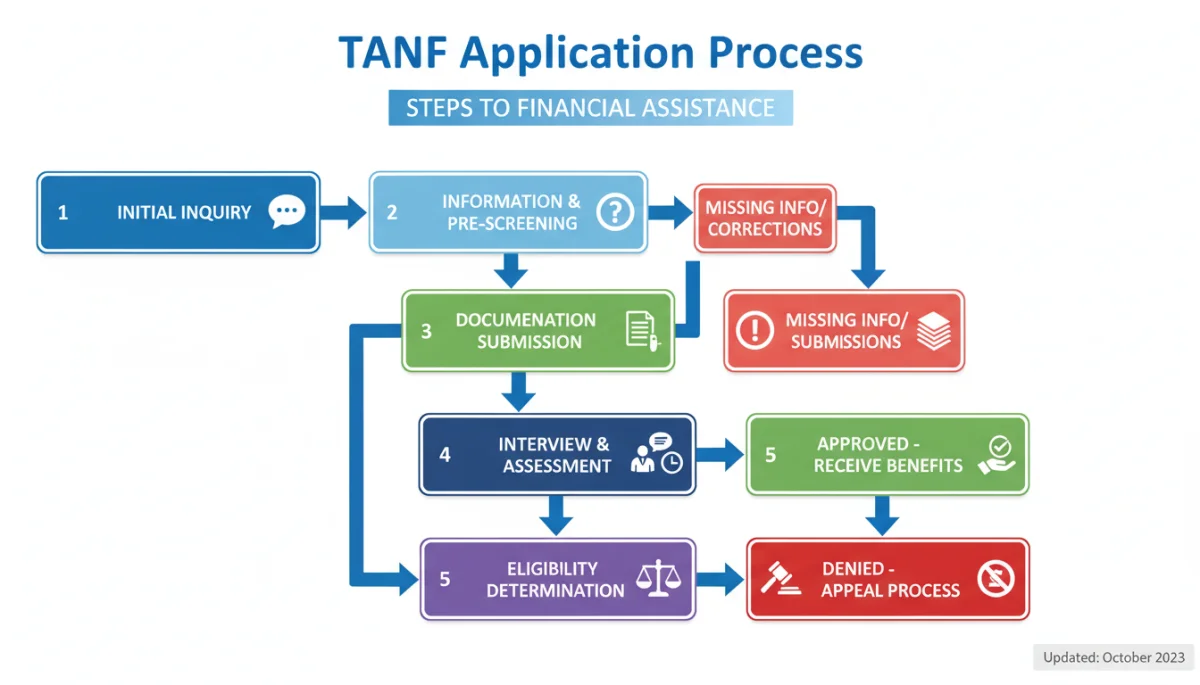
Applying for TANF benefits can be a thorough process, requiring careful attention to detail and documentation. While the specific steps can vary by state and even by local county offices, there is a general framework that applicants can expect to follow. Understanding this process beforehand can help streamline the application and reduce potential delays.
The journey typically begins with an initial inquiry, often made online, over the phone, or in person at a local welfare office. This initial contact helps determine if a family meets the very basic criteria to proceed with a full application. Following this, applicants will usually be required to complete a detailed application form, which gathers extensive information about their household, income, assets, and other relevant factors.
Required Documentation and Interviews
A crucial part of the application process involves submitting various documents to verify the information provided. These documents typically include proof of identity for all household members, proof of residency (e.g., utility bills, lease agreements), income verification (e.g., pay stubs, tax returns), asset statements (e.g., bank statements), and birth certificates or other proof of relationship for children. Gathering these documents in advance can significantly expedite the process.
After submitting the application and supporting documents, most applicants will be required to attend an interview with a caseworker. This interview serves several purposes: to clarify information, to address any discrepancies, and to discuss the family’s specific needs and circumstances. It’s an opportunity for the caseworker to gain a deeper understanding of the family’s situation and for the applicant to ask questions about the program.
Work Requirements and Program Participation
For many adult TANF recipients, the application process doesn’t end with approval. A significant component of the program involves work requirements or participation in work-related activities. These can include job search, job training, educational programs, community service, or unsubsidized employment. States develop individual responsibility plans (IRPs) that outline the specific activities and expectations for each recipient.
- Initial Inquiry: Contacting the state or county welfare office to begin the process.
- Application Form: Completing a detailed form providing household, income, and asset information.
- Document Submission: Providing proof of identity, residency, income, and assets.
- Caseworker Interview: Meeting with a caseworker to review the application and discuss needs.
- Work Activities: Participating in job search, training, or other work-related programs if required.
Failure to comply with work requirements can result in sanctions, such as a reduction or termination of benefits. Therefore, understanding and actively participating in these components is vital for maintaining eligibility. The application process, while comprehensive, is designed to ensure that assistance reaches those who are most in need and are committed to working towards self-sufficiency.
Impact of State Policies on TANF Recipients
The inherent flexibility of the TANF block grant means that state policies have a profound impact on the lives of recipients. Each state’s legislative decisions regarding eligibility, benefit levels, work requirements, and sanctions directly shape the access to and effectiveness of the program for its residents. This creates a diverse landscape of support, where a family’s experience with TANF can vary dramatically simply by crossing state lines.
For instance, states with more generous benefit levels and less stringent time limits may offer a stronger safety net, allowing families more time and resources to stabilize their situations. Conversely, states with lower benefits and stricter rules might see a quicker transition off aid, but potentially at the cost of greater hardship for families unable to find stable employment quickly. These policy choices reflect a state’s economic conditions, political climate, and philosophical approach to welfare.
Innovative State Approaches
Some states have implemented innovative approaches to TANF, focusing on specific populations or experimenting with different service delivery models. For example, some states have invested heavily in programs designed to address barriers like substance abuse, mental health issues, or domestic violence, recognizing that these factors often impede a parent’s ability to work. Others have focused on integrated service delivery, combining TANF with other benefits like SNAP or housing assistance to provide a more coordinated support system.
These innovations can lead to better outcomes for families, helping them not only meet immediate needs but also achieve long-term stability. However, the success of these programs often depends on adequate funding, effective implementation, and ongoing evaluation. As 2026 approaches, states continue to refine these approaches, learning from past successes and challenges to better serve their communities.
Challenges and Disparities
Despite the potential for innovation, state-level variations also lead to significant disparities. Families in states with less robust TANF programs may face greater challenges in securing adequate support, potentially exacerbating poverty and hardship. The differing time limits and work requirements can also create a confusing landscape for families who move between states, as they may encounter entirely new rules and expectations.
- Benefit Level Discrepancies: Cash assistance amounts vary widely by state, impacting families’ ability to cover basic needs.
- Work Requirement Variations: The types of work activities and participation rates differ, affecting recipients’ path to employment.
- Access to Support Services: Availability of child care, transportation, and job training varies, influencing program effectiveness.
- Sanction Policies: States have different approaches to penalties for non-compliance, impacting benefit continuity.
These disparities highlight the ongoing debate about the balance between state flexibility and the need for a more uniform safety net across the nation. For families navigating TANF in 2026, understanding these state-specific policies is not just beneficial, but essential for maximizing the support they can receive.
Future Outlook for TANF in 2026 and Beyond
As we look towards 2026, the Temporary Assistance for Needy Families (TANF) program continues to evolve in response to changing economic conditions, shifting policy priorities, and ongoing debates about its effectiveness. The future of TANF will likely be shaped by discussions surrounding federal reauthorization, state-level reforms, and the broader economic landscape of the United States.
One key area of focus will undoubtedly be the adequacy of benefit levels. With many states’ cash assistance amounts remaining well below the poverty line, there is persistent advocacy for increasing these benefits to better support families. Debates will continue on whether federal incentives or mandates are needed to encourage states to raise their benefit ceilings and ensure that TANF truly provides a sufficient safety net.
Potential Reforms and Policy Debates
Discussions around TANF reauthorization often involve proposals for reforming work requirements, time limits, and the types of activities that count towards participation rates. Some advocates argue for more flexible work requirements that better accommodate individuals facing barriers like caregiving responsibilities, disabilities, or educational pursuits. Others may push for stronger emphasis on job placement and skill development to enhance long-term self-sufficiency.
Furthermore, the debate over how states utilize their TANF block grants is likely to intensify. While the program is intended to assist needy families, a significant portion of TANF funds in some states is allocated to services not directly involving cash assistance or work support for recipients. Future reforms may seek to ensure that a higher percentage of funds directly benefits the program’s core population.
Economic Factors and Program Demand
The overall economic health of the nation will also play a crucial role in the demand for TANF services. In periods of economic downturn or high unemployment, the need for temporary assistance typically rises. Conversely, a strong economy might see a decrease in caseloads, allowing states to potentially reallocate funds to other family support services or maintain reserves. The economic forecast for 2026 will therefore be a significant factor in TANF’s operational context.
- Benefit Adequacy: Ongoing debate about increasing cash assistance to meet basic needs.
- Work Requirement Flexibility: Discussions on adapting work rules to better suit diverse recipient circumstances.
- Funding Allocation: Scrutiny over how states spend TANF funds and ensuring direct benefits to needy families.
- Economic Impact: How national economic trends will influence TANF caseloads and state program designs.
Ultimately, the future of TANF in 2026 and beyond will be a reflection of societal values, economic realities, and legislative priorities. For families, staying informed about these potential changes and advocating for policies that support their well-being will be more important than ever. The program’s evolution will continue to be a critical component of the nation’s efforts to combat poverty and support vulnerable populations.
| Key Aspect | Brief Description |
|---|---|
| Eligibility Criteria | Income, assets, and household composition are assessed, varying by state. |
| Benefit Limits | Cash assistance amounts and duration (time limits) are state-dependent. |
| Application Process | Requires documentation, interviews, and potential work activity participation. |
| State Variations | Significant differences exist in rules and support due to state autonomy. |
Frequently Asked Questions About TANF 2026
Income requirements for TANF in 2026 vary significantly by state. Generally, a family’s gross and net income must fall below state-defined thresholds, often a percentage of the federal poverty level, to qualify for assistance. Checking your specific state’s department of social services website is crucial for accurate figures.
Yes, federal law imposes a 60-month (five-year) lifetime limit on federally funded TANF cash assistance. However, states have the authority to implement shorter limits or grant exemptions for a small percentage of their caseloads due to specific hardships like disability or domestic violence.
Most adult TANF recipients are subject to work requirements. This involves participating in work-related activities such as job search, training, education, or community service. States develop individual responsibility plans, and non-compliance can lead to benefit reductions or termination, emphasizing self-sufficiency.
State policies profoundly affect TANF, as each state designs its own program within federal guidelines. This leads to variations in eligibility, benefit amounts, work requirements, and available support services. A family’s experience with TANF can differ significantly depending on the state where they reside and apply.
Commonly required documents include proof of identity for all household members, residency verification, income statements (pay stubs, tax returns), asset information (bank statements), and birth certificates or other proof of relationship for dependent children. Having these ready can expedite the application process.
Conclusion
Navigating the landscape of Temporary Assistance for Needy Families (TANF) in 2026 requires a clear understanding of its evolving eligibility criteria, varied benefit limits, and the significant impact of state-specific policies. While TANF serves as a vital resource for low-income families with children across the United States, its decentralized structure means that applicants must diligently research and adhere to the regulations of their particular state. The program’s future will continue to be shaped by economic factors and policy debates, underscoring the importance of staying informed and engaged to ensure that this crucial safety net remains effective and accessible for those who need it most.
